
Matthew 1 · Luke 3
The family tree of Jesus
The Gospel genealogies, expanded with Old Testament generations and named mothers. Biblical branches cite Scripture; traditional additions identify their source.
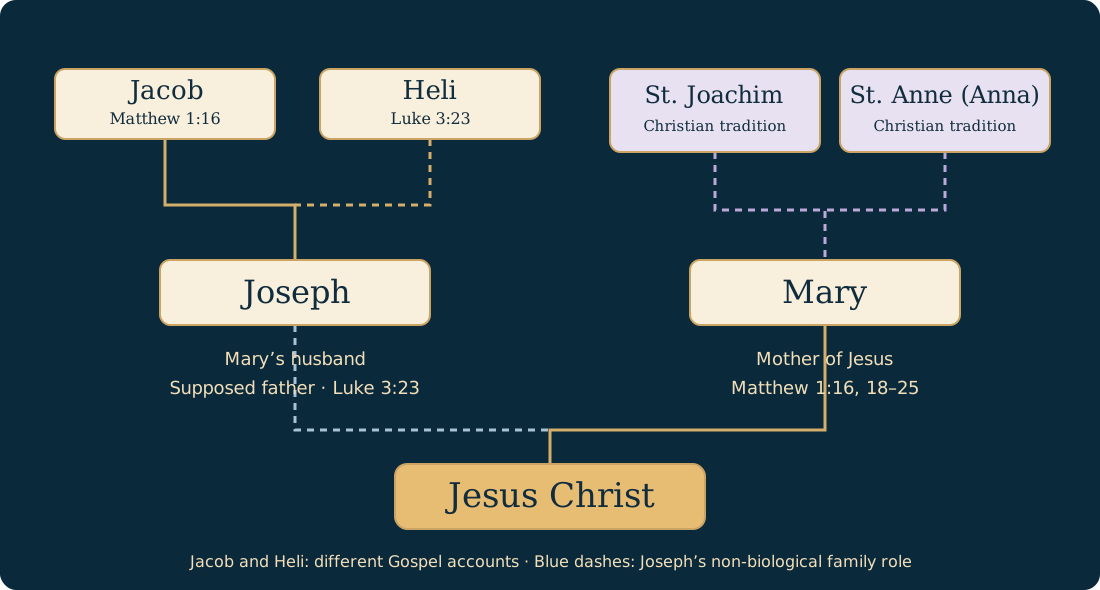
Mary is Jesus’ mother. Joseph is her husband and Jesus’ supposed father. Matthew identifies Jacob as Joseph’s father; Luke names Heli next after Joseph. The two lists are shown as the Gospels record them.
How to read the two accounts
Luke 3:23 calls Jesus the son of Joseph “as was supposed,” then gives Heli next in its list. Matthew 1:16 calls Joseph Mary’s husband and says Jesus was born of Mary. Neither passage explicitly says Luke’s list is Mary’s genealogy, so this chart does not label it that way.
The spellings and some names vary between translations and textual traditions. This chart follows the updated World English Bible as linked below, including Luke’s two appearances of Cainan and the names “Aram” and “Ram” as printed in the respective passages.
Adam to Christ: the expanded chart
Both complete Gospel name lists, four additional generations from Chronicles, and named mothers from Genesis, Ruth, Kings, Chronicles, and Matthew. Rose boxes show mothers; green boxes mark Old Testament additions; lavender boxes identify Christian tradition. Scripture does not supply every biological ancestor or a complete maternal pedigree for Mary.
Scroll inside the chart to follow each branch. Select any name to open its Scripture source.
Open full-size chart for reading or printing ↗
Mary’s relative Elizabeth and John the Baptist
Joachim and Anne: Mary’s parents in Christian tradition
Christian tradition identifies Saints Joachim and Anne (Anna) as Mary’s parents. The Protoevangelium of James, chapters 1–5, recounts their childlessness, prayers, an angelic promise, and Mary’s birth. This work is also called the Gospel of James and is not part of the biblical canon. The lavender branches mark that source distinction.
Pope John Paul II’s Angelus of 25 July 1999 explicitly describes their identification as Mary’s parents as a tradition associated with the apocryphal Gospel of James.
The cited account describes Joachim as wealthy, with flocks and shepherds. It does not establish the specific description “a shepherd from Nazareth,” so that detail is not used here. Joachim is not equated with Luke’s Heli, and no unrecorded connection to David is drawn.
Scripture cross-references & theological notes
Old Testament cross-reference guide
| Part of the tree | Old Testament passages | What can be checked |
|---|---|---|
| Adam through Noah | Genesis 5; 1 Chronicles 1:1–4 | Early name sequence; Enosh/Enos and Kenan/Cainan spellings. |
| Shem through Abraham | Genesis 11:10–26; 1 Chronicles 1:24–27 | Patriarchal line; Luke’s additional Cainan remains a noted difference. |
| Abraham through Judah and Perez | 1 Chronicles 1:34; 1 Chronicles 2:1–5; Genesis 38:27–30 | Isaac, Jacob/Israel, Judah, Perez and their recorded family connections. |
| Perez through David | Ruth 4:18–22; 1 Chronicles 2:5–15 | The line through Boaz, Obed and Jesse; Ruth’s motherhood in Ruth 4:13–17. |
| David’s sons and royal descendants | 2 Samuel 5:14; 1 Chronicles 3:5–19 | Nathan and Solomon; the kings including four absent from Matthew’s shorter list. |
| Shealtiel and Zerubbabel | Haggai 1:1; 1 Chronicles 3:17–19 | Haggai names Zerubbabel as son of Shealtiel; Chronicles lists him under Pedaiah. The chart preserves the difference. |
| Later names in Matthew and Luke | Matthew 1:13–16; Luke 3:23–31 | The cited Old Testament genealogies do not independently supply the full later sequences. A repeated name alone does not establish the same person. |
Royal mothers with differing descriptions: 1 Kings 15:2 names Abijah’s mother as Maacah, daughter of Abishalom; 2 Chronicles 13:2 names Micaiah, daughter of Uriel. The same Maacah is called Asa’s mother and queen mother in 1 Kings 15:10, 13; this chart does not silently turn that into a biological maternity claim. Athaliah’s descriptions in 2 Kings 8:18, 26 and 2 Chronicles 22:2–3 also require attention to the wider family rather than assuming every use of “daughter” means one generation.
Bathsheba / Bathshua: 2 Samuel 11:3 and 12:24 name Bathsheba, daughter of Eliam, as Solomon’s mother. 1 Chronicles 3:5 uses Bathshua, daughter of Ammiel, for the mother of Nathan and Solomon. These are conventionally understood as variant forms; the chart retains the source wording on the two maternal cards.
What the text states: Matthew 1:16 identifies Jacob as Joseph’s father and Mary as Jesus’ mother. Matthew 1:18–25 describes conception by the Holy Spirit. Luke 3:23 qualifies Joseph’s fatherhood and names Heli next. The chart compares the two recorded relationships; it does not say Joseph had two biological fathers.
Mary’s ancestry is an interpretation: Some Christians understand Luke as tracing Mary’s family through Joseph, her husband. Other explanations distinguish legal and natural descent within Joseph’s family. The IVP commentary on Luke 3:23–38 surveys these proposals and regards their reconciliation as uncertain. We therefore do not identify Heli as Mary’s father as an established biblical fact.
An early Christian explanation: Julius Africanus proposed that Jacob was Joseph’s natural father and Heli his legal father through a marriage intended to continue a deceased relative’s line. Eusebius, Church History 1.7, preserves this explanation. It is a historical interpretation, not a relationship explicitly described by Matthew or Luke.
Matthew omits generations: Compare Matthew 1:8, 11 with 1 Chronicles 3:10–16. Ahaziah, Joash, and Amaziah appear between Joram and Azariah (Uzziah) in Chronicles, and Jehoiakim appears between Josiah and Jeconiah. The expanded chart adds these four names in green; the text list retains Matthew’s sequence. Its connecting lines cannot all be read as immediate father-to-son links.
Genesis and Luke have a textual difference: Genesis 5 supports the early line through Noah. Genesis 11:10–26 continues from Shem toward Abraham, but this WEB Genesis text does not include the second Cainan between Arphaxad and Shelah found in Luke 3:35–36. The chart keeps Luke’s reading. Luke 3:33 also has a manuscript variant: Admin and Arni in place of Aram, as the WEB footnote records. Counts and spellings therefore depend on the edition.
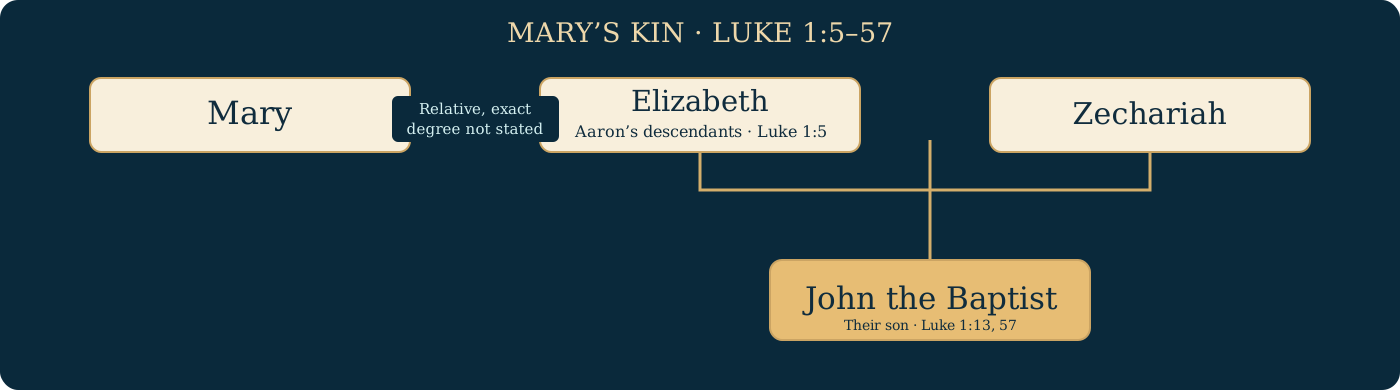
Mary, Elizabeth, and John: Luke 1:36 calls Elizabeth Mary’s relative; Luke 1:5 identifies Elizabeth with Aaron’s priestly descendants, and Luke 1:13, 57 names Zechariah and Elizabeth as John’s parents. Luke does not specify the exact degree of kinship. The chart therefore shows a collateral relation and keeps John outside Jesus’ ancestry.
Shealtiel and Zerubbabel: Matthew and Luke both include these names, but name different fathers for Shealtiel. In addition, 1 Chronicles 3:19 lists Zerubbabel under Pedaiah. The chart does not resolve these differences by assuming an unrecorded adoption or marriage, or by merging the two Gospel branches at these names.
The women Matthew includes: Matthew 1:3–6, 16 also identifies Tamar, Rahab, Ruth, the woman who had been Uriah’s wife, and Mary. The expanded chart adds these women and the other named mothers supported by its Old Testament sources.
Davidic descent through Mary [F]: Romans 1:3 says Jesus was descended from David “according to the flesh.” Because Matthew 1:18–25 and Luke 1:34–35 present Jesus’ conception as by the Holy Spirit, many Christians understand that fleshly descent to be through Mary. The Gospels do not state Mary’s ancestry in the genealogies, and Luke names Joseph in Luke 3:23. The teal line marks this theological inference, not an explicit named parent chain. See Romans 1:3, Luke 1:34–35, and Matthew 1:18–25.
Adam and God: Luke ends with Adam and then God (Luke 3:38). This human ancestry chart begins with Adam; it does not depict God as a human or biological ancestor.
Text comparison: updated World English Bible, Matthew 1:1–25 and Luke 3:23–38; Genesis 5; Genesis 11; 1 Chronicles 3. Theological comparison: IVP New Testament Commentary and Eusebius, Church History 1.7. These notes distinguish biblical wording from later interpretations. [F] labels a Christian theological inference, not an explicit biblical genealogy.
Read all names as text
Adam to Jesus · Luke
Luke 3:23–38 presents these names from Jesus backward. This list reverses the order to follow the family line from Adam to Christ.
- 01Adam
- 02Seth
- 03Enos
- 04Cainan
- 05Mahalaleel
- 06Jared
- 07Enoch
- 08Methuselah
- 09Lamech
- 10Noah
- 11Shem
- 12Arphaxad
- 13Cainan
- 14Shelah
- 15Eber
- 16Peleg
- 17Reu
- 18Serug
- 19Nahor
- 20Terah
- 21Abraham
- 22Isaac
- 23Jacob
- 24Judah
- 25Perez
- 26Hezron
- 27Aram
- 28Amminadab
- 29Nahshon
- 30Salmon
- 31Boaz
- 32Obed
- 33Jesse
- 34David
- 35Nathan
- 36Mattatha
- 37Menan
- 38Melea
- 39Eliakim
- 40Jonan
- 41Joseph
- 42Judah
- 43Simeon
- 44Levi
- 45Matthat
- 46Jorim
- 47Eliezer
- 48Jose
- 49Er
- 50Elmodam
- 51Cosam
- 52Addi
- 53Melchi
- 54Neri
- 55Shealtiel
- 56Zerubbabel
- 57Rhesa
- 58Joanan
- 59Judah
- 60Joseph
- 61Semein
- 62Mattathias
- 63Maath
- 64Naggai
- 65Esli
- 66Nahum
- 67Amos
- 68Mattathias
- 69Joseph
- 70Jannai
- 71Melchi
- 72Levi
- 73Matthat
- 74Heli
- 75Joseph (as was supposed)
- 76Jesus (born of Mary)
Abraham to Jesus · Matthew
Matthew 1:1–16 records this line from Abraham through David and Solomon to Joseph, then names Mary as Jesus’ mother.
- 01Abraham
- 02Isaac
- 03Jacob
- 04Judah
- 05Perez
- 06Hezron
- 07Ram
- 08Amminadab
- 09Nahshon
- 10Salmon
- 11Boaz
- 12Obed
- 13Jesse
- 14David
- 15Solomon
- 16Rehoboam
- 17Abijah
- 18Asa
- 19Jehoshaphat
- 20Joram
- 21Uzziah
- 22Jotham
- 23Ahaz
- 24Hezekiah
- 25Manasseh
- 26Amon
- 27Josiah
- 28Jechoniah
- 29Shealtiel
- 30Zerubbabel
- 31Abiud
- 32Eliakim
- 33Azor
- 34Zadok
- 35Achim
- 36Eliud
- 37Eleazar
- 38Matthan
- 39Jacob
- 40Joseph (Mary’s husband)
- 41Jesus (born of Mary)
Read the source passages
Luke 3:23–38 · Matthew 1:1–16 (World English Bible, public domain).